Posts

The Number One Reason to Love Pastel

Image
I've spent the last 9 posts or so covering some of the most lovable things about pastel. My personal favorite: it shows the artist's unique touch. Brushstrokes are beautiful, and also unique to the artist.  Pastel strokes are made directly by hand, with no brush in-between.  To me, this conveys the artist's power directly onto the surface, making a clear connection between the artist's energy and the medium.  My favorite types of pastels to look at are those with obvious pastel strokes, so that the picture almost quivers with life. A quick, textured pastel study holds so much more power to me than a detailed, well-blended painting.  Everyone has their own taste in art; for me, the immediacy of a rough pastel sketch is like getting a quick peek into the artist's mind.  Some think that pastels might be the first type of art medium used (think of cave art, most likely created by sticks of pigment). I can appreciate almost any type of hand-created art, in j...

10 Reasons to Love Pastel: A Plethora of Possibilities

Image
Yes, I learned the word "plethora" from Three Amigos.   There is some evidence that the earliest art created by humans was likely painted with an ancient version of pastels (think cave painting).  There is something about gripping that pastel stick in my hand that makes me want to scratch color on all kinds of things. Pastel allows you to directly make your mark, with no brush getting between you and the color. "Curiosi-Tea" 7 x 10 Pastel on Cardboard Click here to view large or see purchase details I've used pastel on many surfaces: textured pastel paper, watercolor paper, drawing paper, canvas, Canva-paper, and stationery and envelopes to name a few.  I can now add cardboard to the list.   "Quiet Still Life" 9 x 12 Pastel on Cardboard Click here to view large or see purchase details I noticed that the texture of the cardboard itself makes a difference in the pastel's texture.  I also had to use fixative to keep the colors stron...

10 Reasons to Love Pastel: Easy to Learn!

Image
 "Fallbrook Field" 8 x 12 Pastel on Paper Click here to view purchase details This is my 200th post.  I was heartbroken to find out that my absolute favorite art teacher (well, next to my grandma of course), David Musser, passed away in December.  You can see David's art here. I took my first pastel class with David in 2004.  Before then, I didn't even know what soft pastels were, since I'd only used oil pastels.  I struggled at first, and was especially mortified when he pulled a chair up next to mine and said he was going to make me his "special project," and that I'd be able to use pastels with ease in no time.  Fortunately, he was right! I could fill an entire blog with things I learned in David's classes (I continued with pastel, and also took some basic drawing and watercolor classes with him over the years).  He was one of the most entertaining people I've ever met, and he truly enjoyed helping his students create-- he shar...

Number 4 of 10 Reasons to Love Pastel: Push-Pull

Image
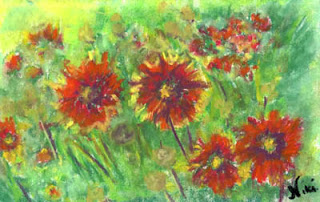
"Hippie Flowers" 6 x 9 inch pastel on drawing paper Click here to view large or see purchase details December usually isn't the best time for me-- everything seems to hit the fan mid-month, leaving me exhausted (and this time sick) by the time the holidays are over.  These little flowers cheered me up as I worked on them (I called them "Hippie Flowers" because they reminded me of something from the sixties). In spite of that, I've been working for a while on a few pieces to demonstrate one of my favorite elements of painting with pastel: the delicate push-pull between the soft, blended areas and the bolder, harder lines and strokes. One of the most relaxing things I can think of to do is to smear a pastel painting. In my first pastel classes, we learned to block in areas of color and smear the painting as a whole to achieve that soft background effect unique to pastel.  After a layer of fixative (if desired), we would then go back over the piece, a...

10 Reasons to Love Pastel: Soft Impressions

Image
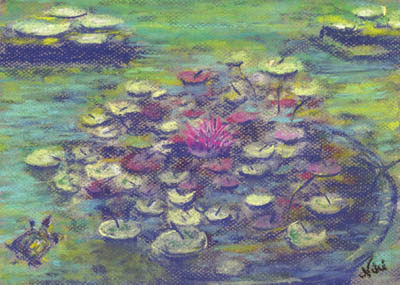
I believe I've made it to number five of my 10 reasons to love pastel: it's a natural choice for impressionists! "Balboa Turtle" 9 x 12 Pastel on Paper Click here to view large or see purchase details  If you're a fan of the Impressionist Movement, chances are you've enjoyed a few pieces created with pastel.  Pastel lends itself naturally to the quick strokes and dappled lights and darks of the impressionist style, and it's relatively easy to use in a plein air (outside) or alla prima (all in one session) painting setting.  The soft, smeary nature of dry pastel also makes it an ideal medium for paintings that focus on overall lights and darks without a lot of hard line and detail.  "Balboa Water Lilies" 9 x 12 Pastel on Paper Click here to view large or see purchase details   I was lucky enough to visit Musee D'Orsay  as a teenager (thanks to my generous host parents when I was an exchange student), and I couldn't w...

10 Reasons to Love Pastel: Lights and Shadows

Image
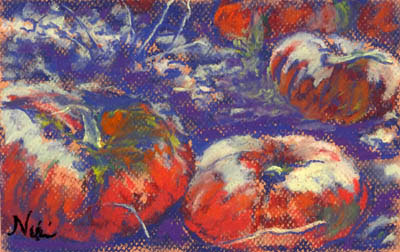
"Bitter Harvest" 6 x 9 inch Pastel on Paper Click here to view large or see purchase details One of the things I tend to mess up when using pastel is that I often lose my lights.  When I remember to be careful and maintain contrast, the outcome is usually much better. It took me a few years of working with pastel to realize that soft pastels layer in better dark to light.  I now know that it's important to save those lights for the end, and make sure they have plenty of room in my paintings.  Adding lights too early contributes to "mud," when colors blend together in a way that makes them look dull.  I still use up my lighter colored pastels much quicker than my dark ones-- a little dark pastel goes a long way, whereas the lighter colors need a few layers to really stand out.  Using a toothy pastel paper gives the light pastel something to grip, making it stand out even more. "Bitter Harvest II" 6 x 9 inch pastel on paper Click here to...

10 Reasons to Love Pastel: Texture!

Image
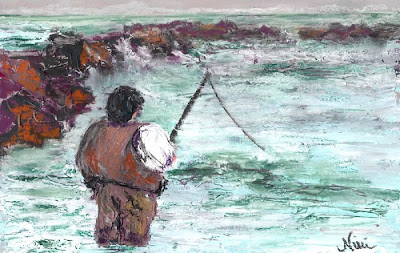
Reason #7 to love pastel: You can get great texture effects with it! "Fishin', Hopin', Prayin" 8 x 12 inch Mixed Media on Paper Click here to view large or see purchase details I always enjoy using a palette knife to create heavily textured paintings, but I enjoy the process even more when I finish the piece with a couple of layers of pastel (oil or soft pastel work great, but they each have different effects). Click here to view a tutorial on Empty Easel featuring the technique I used for this piece! For the piece above, I started with some photos I had taken on a cold afternoon at a crowded beach.  I wanted to capture the cold feeling of the day, so I used cool tones to create the water, painting in the strokes with a palette knife.  Once the acrylic dries, it's ready for the pastel, which can be scraped lightly over heavily textured parts or layered in as you would normally use pastel for the smoother areas of the piece.  Combining acrylic with p...